Three of Cupson the cup that becomes a circle
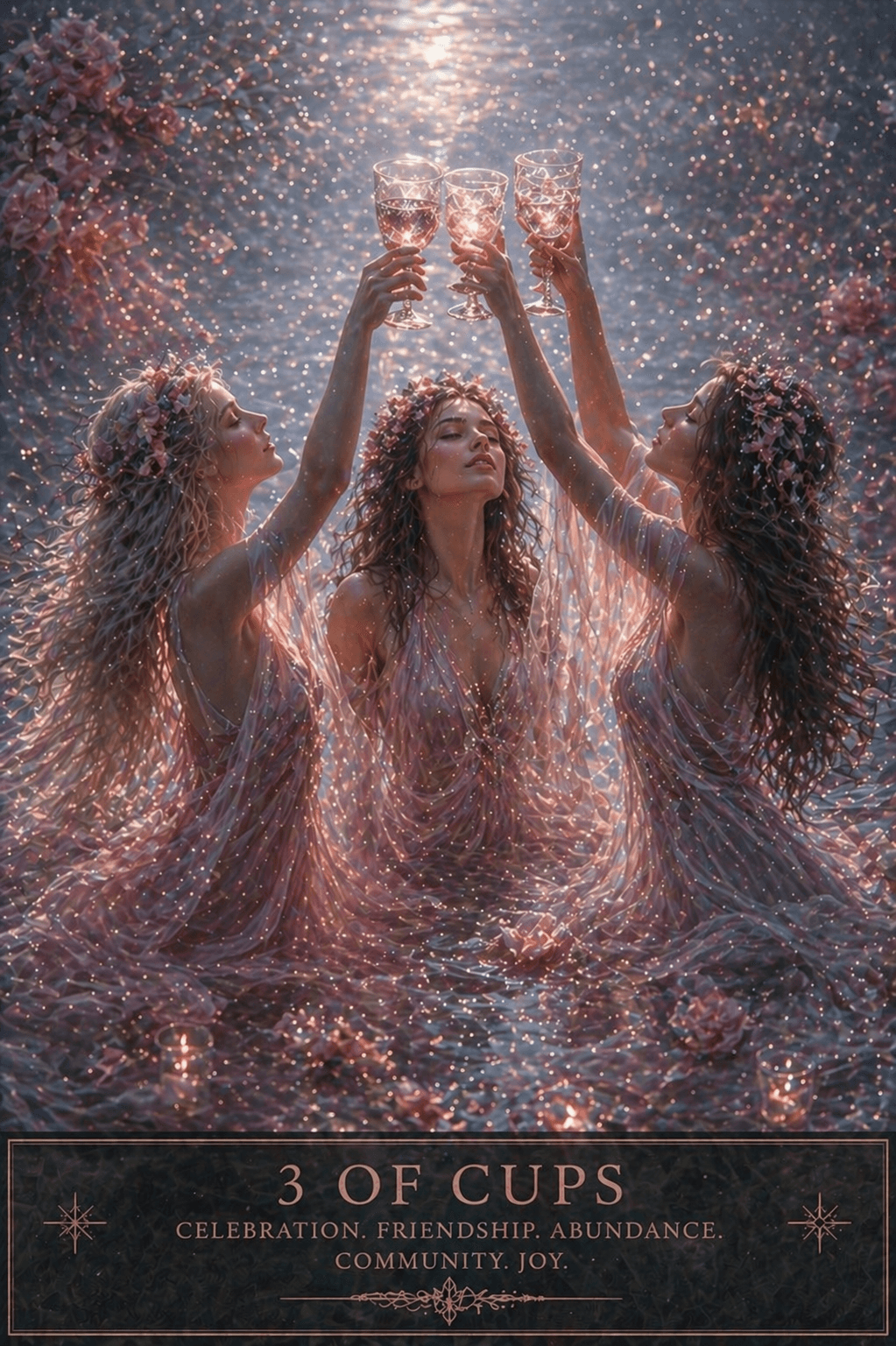
Three figures, dancing.
In the Rider-Waite-Smith deck, they stand in a tight circle, their bodies turned toward each other. Their cups are raised high. One wears red, one wears cream, one wears gold or pale orange. They wear wreaths of flowers and fruit on their heads. At their feet, pumpkins and pomegranates and grapes — the harvest already gathered. They are toasting. They are laughing. They have not been alone in a long time.
This is the Three of Cups — the card of joy made communal, of cups that have become a circle, of the people who held you through what you survived. After the cup arrives in the Ace, and is shared with one other in the Two, here it becomes the gathered ones. Three is when the circle begins.
In some traditions, this card is called the sisterhood card. The bridesmaid card. The card of the godparents and the chosen family and the people who showed up. But it is bigger than just biological sisters or female friends. It is for everyone who has ever raised a cup with the people who knew them when.
To draw this card is to be asked: who held you?
Who were the friends who came to the hospital? Who brought soup when the marriage ended? Who sat with you on the porch the night your mother died? Who texted at midnight asking are you okay, really?
The Three of Cups is the gratitude card. The card that says: don't forget who carried you. Don't forget that you did not arrive here alone. Don't forget that joy, when it is witnessed, becomes more real — not less.
She is also the card of the harvest. The fruits at the feet of the three dancers are not abstract. They are real apples and grapes and pomegranates — what was grown. What was earned. What the long year produced. And the dancers do not eat alone. They eat together. The harvest becomes a feast because there are three of them to share it.
Joy, when it is witnessed,
becomes more real — not less.
When the Three of Cups appears in your reading, it is rarely subtle. Something is being celebrated. A wedding, a graduation, a baby being born, a recovery being noticed, a project finally seen. Or: it is the invitation to celebrate — to call your three, your four, your seven, your beloved circle, and tell them you survived something hard. The card almost always asks the same thing: gather. Raise the cup. Mark the occasion.
Reversed, she is the friendship that has gone sour. The inner circle that closes someone out. The gossip that pretends to be loyalty. The over-celebration that becomes its own kind of avoidance — drinking together to not feel what is underneath the drinking. Reversed, she asks: is this circle still mine? Is the gathering nourishing, or is it numbing?
She is also, quietly, the card of the witness.
Your joy needs witnesses. Your grief needs witnesses. Your becoming needs witnesses. The Three of Cups is what happens when the witnesses arrive — not as observers, but as participants. They do not just watch you celebrate. They raise their own cups beside yours.
This is the function of community that nothing else replaces. You can journal your joy alone, and the joy is real. You can pray your grief alone, and the prayer is real. But there is a particular kind of completion that only comes when three or more gather. The completion of being known.
There is something else worth saying about this card.
The three dancers are not identical. Look at them: different colors of clothes, different postures, different positions in the circle. The Three of Cups is not the card of agreement. It is the card of difference held in a single circle. You do not have to be the same as the people you celebrate with. You do not have to share their politics, their religion, their tastes. You only have to be willing to raise the cup beside theirs, and let theirs be raised beside yours.
In an age of curated friendships and algorithmic connection, this is worth saying twice: the people in your circle do not have to be like you. They only have to show up for you, and let you show up for them.
Welcome her in. Pour the wine, or the tea, or the sparkling water. Call the people who know you. Tell them what you survived. Let them tell you what they survived.
The cup arrived in the Ace. It deepened in the Two. And here, in the Three, it becomes a circle. A circle that does not have to close.
Raise the cup. The harvest is in. The gathered ones are here.
Upright & Reversed
Celebration. Friendship. Community. The gathered ones. The harvest shared. Joy made communal. The witnesses of your life. Anniversaries, graduations, weddings, baby showers. The chosen family. The circle of three. The bridesmaid, the godparent, the friend who came to the hospital. Toasting, gathering, the shared cup. Gratitude for those who showed up.
The friendship gone sour. The inner circle that excludes. Gossip masquerading as loyalty. Codependent friendship. Over-celebration as avoidance — drinking together to numb instead of celebrate. The performance of community without the substance. The toxic group. Or, more simply: loneliness. The absence of the gathered ones.
I let my joy be witnessed.
I am the third cup.
The Iconography
To stand before the Three of Cups is to witness a private joy made visible. Every element on the Rider-Waite-Smith card belongs to the celebration.
When She Appears in Your Reading
She is the gathered ones. The circle of three. When she appears, listen for which kind of gathering is being asked of you.
The card asks about the community around the couple. Are your people witnesses to this love? Is your friendship circle invited in, or are you isolating? Upright, the relationship has the blessing of community — the friends who know, the family who supports. Reversed, the relationship is becoming insular, or one partner is being cut off from their friends.
Collaboration. The team. The collective project. The art that needs other people to come alive. Upright: a fertile creative community, mentors, peers, co-creators. Reversed: the team has become dysfunctional, or you are trying to make alone what wants to be made together.
You are in a season of gathering. Look around. Notice your three, your four, your seven. Notice who is showing up. The card almost always means: someone is celebrating something near you — or you are being asked to.
A celebration is coming. A wedding, a graduation, a moving-out party, a recovery anniversary. Make room in your calendar. The gathered ones will need you.
Friendship. Community. The people who knew you when. Calling someone. Saying thank you. Throwing the small party. Making the toast. Less performing for strangers, more tending to the ones who already love you.
The friendship that has become a habit, not a nourishment. The circle that closes others out. The gossip that pretends to be loyalty. The gathering that has become a kind of numbing.
Yes. A communal yes. A yes that is also a toast. The kind of yes that wants to be sung, not whispered.
Her Lessons
Seven things this card has been quietly teaching, if you have been listening.
Joy needs witnesses.
You can journal your joy and the joy is real. You can pray your grief and the prayer is real. But there is a completion that only comes when three or more gather. Witnessed joy is whole joy. Do not assume your joy is a private matter to be kept small and hidden. It is, sometimes, exactly the thing someone else needs to see.
The circle is the unit of belonging.
You are not just a self. You are not even just a couple. You are part of a circle of three or more — the people who know you, who you can call when something hard happens. Identify your circle. Name them. Tell them. Treat the circle as the holy thing it is.
The harvest is for sharing.
Whatever you grew in the long year — bring it to the table. The new chapter. The hard-won healing. The work you finally finished. Joy hoarded is joy diminished. Joy shared is joy multiplied.
Different is not divisive.
The three dancers wear different colors. They are not the same age, not the same shape, not the same dressed. You do not have to be alike to be in a circle. In an age of curated tribes, this is worth saying twice: the people in your circle do not have to share your politics, your aesthetics, your beliefs. They only have to show up for you, and let you show up for them.
Crown each other.
The dancers wear wreaths they have made for each other. Adornment is a form of love. Put a flower behind your friend's ear. Notice the dress. Tell them they are beautiful. Send the card. Make the small ritual of marking the moment.
Honor the ordinary anniversaries.
Not just weddings and graduations. The friend's first day back at work. The first morning sober. The third Saturday after surgery. Every survival deserves a toast. Show up for the small celebrations that the world will not throw a party for.
Raise the cup, even alone.
Sometimes — many times — the gathered ones are missing. The friend who died. The mother who is not yet on speaking terms with you. The community you have not yet found. Raise the cup anyway. The Three of Cups is also for the ones who are not here. The toast that includes them sends them love across the distance.
Gatherings Across Cultures
Every culture knows the circle of three. Every tradition knows that joy and grief both need witnesses.
The Three of Cups is what happens when humanity remembers that we are made for gathering. Wherever your tradition's circle is, that circle has always been the Three of Cups.
Sacred Correspondences
- Number
- III — the trinity, the triangle, the holy completion of three
- Suit
- Cups — the suit of water, feeling, the heart
- Element
- Water — flowing, deep, communal
- Astrology
- Mercury in Cancer (in the Golden Dawn tradition) — communication held in nurturance
- Season
- Late summer into early autumn — the harvest moment
- Day
- Friday — Venus's day, the day of friendship and beauty
- Color
- Cream, gold, soft red, harvest orange, pale rose
- Stones
- Rose quartz, amethyst (the wine stone), citrine, garnet (the friendship stone), pearl
- Plants
- Pomegranate, grapevine, autumn leaves, marigold, rose, harvest fruits
- Scents
- Wine, autumn spices (cinnamon, clove), rose, citrus, fresh-baked bread
- Goddess kin
- Aphrodite (love & gathering), Demeter (the harvest), Yemoja (the circle includes ancestors), the Three Graces — Aglaea, Euphrosyne, Thalia (beauty, mirth, good cheer)
- Tarot kin
- The Empress (her abundance), Ace of Cups (the cup arriving full), Two of Cups (the cup shared with one), Ten of Cups (the long-form Three of Cups, family at the end of the season)
Songs She Knows by Heart
- You've Got a Friend — Carole King
- Closer to Fine — Indigo Girls
- With a Little Help from My Friends — The Beatles
- We Are Family — Sister Sledge
- Wagon Wheel — Old Crow Medicine Show
- Three Little Birds — Bob Marley
- Friends — Whitney Houston
The Three Toasts
This is a ritual for the Three of Cups — a small ceremony of gathering. It can be done alone, or with one or two of your beloveds in person or on the phone. Either way, the practice is the same: three toasts, three witnesses, three names.
- Three small cups (or one cup, raised three times)
- A beverage you love — wine, tea, sparkling water, coffee, milk
- Three small candles (white, coral, or any color)
- A piece of paper and a pen
- About twenty minutes
- (Optional, lovely: one or two friends, in person or on the phone)
Begin: Light the three candles. Set the three cups in a small triangle. Pour your beverage into each cup. Sit before the triangle.
The Practice:
- Lift the first cup. Say aloud: "To the ones who have witnessed me." Take a sip. Think of the people in your circle right now — the friends who would come if you called. Name three of them in your mind, or aloud. Set the cup down.
- Lift the second cup. Say aloud: "To the ones who are no longer here." Take a sip. Think of someone you have loved who is no longer present — through death, distance, estrangement, change. The Three of Cups is also for them. Set the cup down.
- Lift the third cup. Say aloud: "To the ones who have not yet arrived." Take a sip. Think of the future circle — the friends you have not yet met, the gathered ones who are still on their way. Name what you hope they will be like. Set the cup down.
On the paper, write the names of everyone you toasted — those present, those gone, those not yet here. Fold the paper and place it under one of the cups.
To close: Blow out the candles, one at a time, naming each blowing for a different person you toasted. Drink the remaining beverage in each cup. Send a text or make a call to one of the people you toasted — even just "thinking of you today." The ritual is complete when the message is sent.
Three Graces, Three Dancers, Three Cups —
gathered ones, raising the toast,
the harvest already in your hands —
come.
Find me in the season I have been celebrating alone.
Find me at the table I have set without inviting the others.
Find me in the joy I have been afraid to share, in case it disappeared.
Remind me that joy made small does not last longer.
Remind me that the cup, when shared, becomes a circle.
Remind me of the names I have not yet thanked.
Let me crown my people, in this season.
Let me be crowned, in return.
Let me raise the cup for those who could not raise theirs.
The harvest is in.
The gathered ones are here.
The circle holds, the circle holds, the circle holds.
Journal Prompts
- Who are the three (or four, or seven) people I would call if something hard happened tomorrow? When did I last tell them I'm grateful for them?
- What harvest am I sitting with right now — what have I survived, learned, or completed — that I have not yet brought to the table?
- Where in my life have I been hoarding joy, as if it were a private possession? Who deserves to know about it?
- Who in my circle is not like me — and what has that difference taught me?
- If I were to raise three toasts tonight — to the present circle, to the ones gone, to the ones not yet arrived — what would I say?