The Empresson being a body the world cannot stop giving to
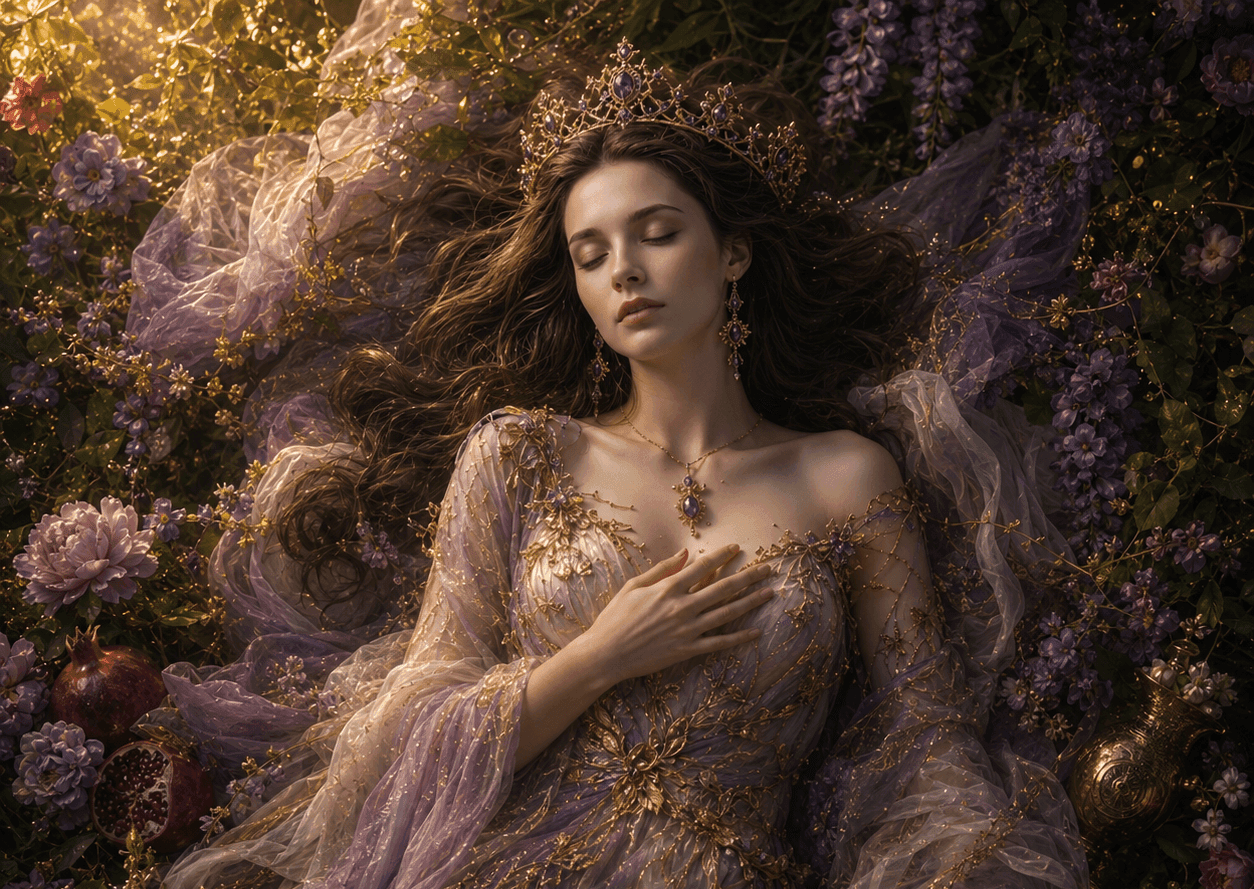
She is the mother. Not always the one who raised you — sometimes the one you needed and never got, the one you became for yourself, the one who lives in the garden behind your sternum and whispers, eat the pomegranate. Drink the water. Lie down in the warm grass.
She wears a crown of twelve stars. Twelve months. Twelve hours of light, twelve of dark. She belongs to the whole cycle — not just the harvest, not just the bloom. The bare-tree months are hers too. She does not panic in winter.
She sits in a green field, on a soft throne, with pomegranates stitched into her dress. Behind her, a river runs — abundance not yet wasted. Around her, wheat is rising — the harvest already promised. At her feet, a heart-shaped shield is marked with the symbol of Venus, who is her younger aspect on a softer day.
She is the answer to the question your tired body has been quietly asking: what would it be like to be cared for without performing for it?
To meet her is to remember that love is not something you must constantly earn through exhaustion or sacrifice. You are not here to prove your worth through endless labor. You are a garden. And gardens are not watered because they have earned it. They are watered because they are alive, because they are worthy of tending, simply by their nature.
When she arrives in your reading, she is saying: receive, beloved. Be lavishly given to. Do not apologize for taking up the soft chair, or the second piece of bread.
This is not laziness. This is not selfishness. This is the most ancient form of devotion — to be a body the world cannot stop giving to.
You are not here to prove your worth through endless labor.
You are a garden.
The Empress in reverse is the one who has forgotten the river is theirs. Who buys their own birthday flowers without telling anyone. Who feeds everyone before themselves and calls it generosity. Who refuses to sit down because they do not yet believe they are allowed to be tired.
If you have drawn her in this position, she is asking you, gently, to notice where you have made earning a condition of love. And to stop.
She is the body letting itself be held. The afternoon that is not productive. The garden that wakes you up by being beautiful. The voice in the kitchen that says, finally — sit down. Eat the apricot. Read for an hour. Nothing will fall apart.
She is the slow making, the long ripening. She is the reminder that creativity is fertility, and fertility does not happen on a deadline.
Welcome her in. The garden is ready.
Upright & Reversed
Abundance. Mother-energy of the broadest kind. Sovereignty of the soft sort. The body as garden. Pleasure as devotion. Receiving with grace. The slow making. Fertility — of body, of art, of project, of self. The lush life. The full harvest. The willingness to be cared for.
Over-giving until the soil is exhausted. Forgetting the river is yours. Withholding from your own creative life. The body treated like a machine. Self-care turned to performance. Comparing your garden to someone else's. Refusing — still refusing — to sit down.
I let myself receive.
I am the garden, and the gardener.
The Iconography
To stand before her card is to read a garden in symbols. Every element on the Rider-Waite-Smith Empress speaks; nothing was placed for decoration alone.
When She Appears in Your Reading
She is rarely subtle. When she arrives, listen for which version of her is speaking. She is asking for something specific.
She is the body letting itself be cherished. Upright, the relationship — or the question — is being asked to soften, deepen, become more tactile, more abundant. Less performance, more presence. Reversed, someone is over-giving and going hungry for it.
She blesses the slow project. The work that is not yet a profit. The art that is incubating. Upright, she says: your creative season is here; protect it. Reversed, she warns of pushing the creative river — trying to harvest grain that hasn't ripened yet.
You are in an abundant moment, even if you have not yet noticed. Look at what you have grown. Look at who is being fed. Look at what is in flower. The Empress almost never lies about this — when she shows up here, there is more in your life than you have been letting yourself count.
Something is being made. It is taking its time. The making is not yours to control — it is yours to attend to. Tend the soil. The harvest will come.
Receiving. Soft hands. Pleasure. The body. The garden. Saying no to one more obligation so a yes can arrive. Walking instead of rushing. Cooking the slow thing.
The belief that you must earn love. The habit of feeding everyone first. The comparison to other people's gardens. The refusal to sit down.
Yes. Slow yes. Lush yes. The kind of yes that needs time to bloom.
Her Lessons
Seven things she has been quietly teaching, if you have been listening.
Receiving is a practice, not a permission slip.
You will not become good at it by accident. You will become good at it by practicing being given to — small things first. A compliment. A free coffee. A door held open. Let each one land. Let none of them be quickly disowned with "oh, you didn't have to." She did not have to. That is the point.
Creation has its own time, and it is not your time.
You cannot rush a pregnancy, or a project, or a piece of writing that wants to be born. You can only tend the conditions. Water. Warmth. Long looking. The making knows what it needs. Your job is to stop interrupting it.
The body is the garden, not the gardener's tool.
She is not a vehicle for your mind. She is not a vending machine that takes labor and outputs love. She is a green and living thing that responds to tenderness, to good food, to rest, to being seen. Tend her the way you would tend a garden you actually loved.
Beauty is a form of devotion.
Not vanity. Not performance. The act of arranging your kitchen so the morning light hits the cup. The act of choosing a flower for the table. The act of taking the longer walk home because the light is better. Beauty, slowly, is a way of saying: I am here. I am paying attention. I am consenting to be alive.
Sovereignty is soft.
Authority does not have to be loud. It does not have to be sharp. You can hold a kingdom from a soft chair. You can say no without raising your voice. The Empress's power is not contradicted by her tenderness; her tenderness is the form her power takes.
Mothering is not just for mothers.
It is for anyone who has decided to keep something alive — a child, a friendship, an old grief, a fragile new project, an inner self that almost did not survive. The work of mothering is universal, and the Empress recognizes you, whatever your role, when you are doing it.
The harvest cannot be rushed.
Whatever you are growing — give it time. Whatever you have been growing for years and have not yet seen — keep growing it. The wheat in her foreground was not pulled up by its roots to check. She trusts the field.
The Archetype Across Cultures
The Empress is a face. The mother-creator is much older than tarot.
The Empress is what happens when you give all of these one face on a card. She is none of them entirely and all of them a little. Choose the version that lives in your own lineage. She will recognize you.
Sacred Correspondences
- Number
- III — the trinity, the triangle, the creative third
- Planet
- Venus
- Element
- Earth (in some traditions, Water)
- Day
- Friday — Venus's day
- Season
- Late spring into early summer — the green that has just become abundant
- Color
- Sage green, rose, gold, soft cream
- Stones
- Rose quartz, emerald, jade, moonstone, green aventurine
- Plants
- Roses, pomegranate, wheat, myrtle, apple, lily, peony
- Scents
- Rose, vanilla, honey, jasmine, sweet earth after rain
- Goddess kin
- Demeter, Venus, Aphrodite, Isis, Yemoja, Gaia
- Tarot echoes
- Queen of Pentacles (her grounded form), Queen of Cups (her tender form)
Songs She Knows by Heart
- Songbird — Fleetwood Mac
- Crowded Table — The Highwomen
- She — dodie
- Wildflowers — Tom Petty
- Pink Moon — Nick Drake
- I Will — The Beatles
- Harvest Moon — Neil Young
The Empress Ritual
A ritual for The Empress takes twenty minutes and asks almost nothing of you. It is the opposite of striving. It is the practice of being given to.
- A piece of fruit (she likes pomegranate, but any will do)
- A glass of cool water
- One flower from outside, or one you bought yourself
- A soft place to sit — the floor, a cushion, a chair that holds you
Begin: Light a candle if you have one. Place the fruit, the water, and the flower in front of you. Sit down. Take three slow breaths into your belly. Notice that you are, in this moment, not being asked to produce anything.
The Practice:
- Pick up the flower. Hold it close enough to see the small specific things — the veins, the petals, the slight imperfections. Say aloud: I see you. Thank you for being beautiful for me today.
- Drink the water. All of it. Slowly. Notice that the water came to you across miles of pipe, or earth, or sky. You did not have to chase it. It arrived.
- Eat the fruit, slowly. Let it be the only thing happening. Notice the wet and the sweet and the way your body answers without being asked.
- Sit for two minutes after. Do not start the next thing. Let this be the next thing.
To close: Bow your head, hand on heart, and say: I am the garden. I am the gardener. I am, in this moment, lavishly cared for.
Empress, Mother, Lush One —
you who wear the twelve stars,
you who sit in the soft chair,
you who never apologize for the harvest —
come.
Find me in the part of my life that has forgotten the river was mine.
Find me in the kitchen I have not yet sat down in.
Find me where I am earning love I was already promised.
Remind me, slowly,
that I am a garden,
not a factory.
Let me be a body the world cannot stop giving to.
Journal Prompts
- Where in my life am I treating love as something I have to earn?
- What does my body keep telling me she would like, that I have not yet given her?
- If I were to receive — fully, without performing gratitude — what is one specific gift I would let myself accept this week?
- What part of my creative life is asking to be lavishly tended, the way one would tend a garden?
- If I were the Empress of my own life — for one hour today — what would I do differently?